Monday, April 18, 2011

Blue

Blue


Blue, blue,  corybrantic blue

Majestic, boundless faded watchet hue,

Unleash the spring, unchain the devil,

Raise me up, feed me to the evil.


Blue, blue, deep sea-blue

Sighing, breathing labile vertu,

Speak to me in whispers, speak to me in shouts,

Bring to me the fire, bring to me your bouts,


Blue, blue, cruel, sunny-blue,

Reckless, temerous, in sapphire pareu,

Spell me life, speak of doom,

Break the nox, set life abloom,


Blue, blue, omniscient, nihiliscent blue,

My paramour, my love, my death-bearing beau,

Bring to me the end, let me your blue defy,

Show me the world and in your blue let me die.

Tuesday, March 22, 2011

The Diseased


Nothing aggravates me in a fine March morning, when the sky is blue, the Bohea steaming, and my general mood in the pink, like seeing a buffoon venditating its momentary physical discomfort on a popular virtual forum. Directly I catch sight of such lame “status messages” as down with flu or suffering from a stomach pain, and my morning bonhomie transmogrifies to a bitter sneer, and I catch the distinct aroma of a singeing disposition. On not less than six or seven occasions in the past couple of week have I been, unwillingly, the reader of the trivial physical discomforts of my virtual acquaintances. And on every occasion I have wondered how we are supposed to reciprocate to such consequential physical discomforts of our beloved web-pals? Are we supposed to cry, or better still, howl? Are we supposed to give them a hug, a kiss? And how such actions could prove to be efficacious in alleviating the pains of the subject is lost on me. I agree that the unwritten laws of the society entail us to show concern for the health and wellbeing of our brethren, but does that involve showing unneeded love on undeserved recipients. Why is it that a certain section of our educated, seemingly wise and extrovert population take it for granted that they are the cynosure of our eyes, our own Adam and Eve, our paradisiac fruit that need contact watching and attention? Why is it that within the confines of the bijou virtual compartments we maintain we cannot spend one happy day without being pestered by needless information? When a world is being wrecked by a war on despotism carried out in a community that lives with us in the same world that we inhabit, when people are still recovering from the throes of a devastating earthquake in a land that is linked to us by means of humanity, do the scattered cases of a homely viral fever, or a menstrual cramp, or, for that matter, a sudden change of mood, matter? What amazes me, even peeves me, is the way a section of our younger and even matured unit are blithely discarding the serious aspects of a worldly life for a homely self-centric one. If one keeps her eyes open one can catch the discrepancy in the points of view I am talking about: on one hand one will witness great democratic feelings unleashed in the social area that can crumble the ivory tower of a tyrant while on the other a carefree unconcern for anything except self. The attitude struck me square in the face when I disembarked at the Delhi airport and caught sight of the glammed up metropolitan city that I now call my home. The city of Gurgaon is one of the lushest cosmopolitan conurbations in India. It cups in its palm the most expensive restaurants, bar, fashion stores and its hip population. In many ways it is as snazzy as New York or Los Angeles, and the average cost of living, as you can guess, touches the zenith in the economic scale; yet, in this seemingly, well-maintained, well platted out, organized metropolitan hub, you will easily catch such diseases as child labor, abject poverty, chill penury. As soon as you cross the polished, glassy façade of the skyscaperized city you will, if you have the eye, that is, catch the glimpses of pain and distress: children with perpetually hungry eyes specter thin in form looking for food; women, emaciated, bare-boned extending their hands in the hope of small charity; men, hollow, shadowy forms working under the beating sun to build brick by brick glass palaces to be inhabited by the fortunate ones. Who will listen to their disease; how shall you reciprocate to their pains? The whole city riding expensive cars and spending needless money on “imported” goods turns a blind eye to these agonies. They behave as if the less fortunate ones do not exist, they turn their gaze, and they close their hearts, deliberately. Let me share a small incident with you: a day or two after I relocated to India, my husband and I went for a snack. We had in our mind delicious Indian snacks available in a food stall near the guest house we had been staying at the time. As we enjoyed the hot treat a small girl dressed in an almost threadbare outfit and displaying an unbearable hungry countenance approached us. I asked her what she wanted to eat and she said she wanted a “samosa,” a deep fried Indian treat I am sure many of you are aware of. My husband took the girl to the shop and bought her a couple of samosas. She left the shop in quick steps carrying the bag of food. I stood in my place watching her moves: she reached a side street where her mother sat, placed the bag on her mother’s lap. She washed her hands at a washbasin adjacent to a temple that stood in the area, wiped them in the loose end of her mother’s saree, sat by her and began eating. I cannot tell you why, but the happiness I felt that day watching the child enjoy the little treat is greater than some recent great joys. I thanked God for bringing me to the spot that A.M., for allowing me to help the girl in our little way. At the same time, I couldn’t turn away from the fact that a portion of my fellow human beings, rich, well-fed, topped to the north in silk attire, is sick. Apathy is a disease that has marked them as her own, and they are unaware of it, or they simply do not care. Compared with the inconsequential, barely there diseases that wreck my virtual pals this disease of apathy is a grim discomfort that eats away the heart and kills the human spirit. This is a disease we need to be concerned about; this is an ailment that needs prompt attention, potent medicine and regular treatment.

                           Raise a voice and help stop child labor in India.


Monday, February 14, 2011

On Valentine's Day


Contrary to the expectations of the young lovers, the sun on Valentine's Day did not resemble a giant heart dancing high up in the sky, and neither did the nightingale sing Justin Bieber's Baby. Valentine's Day has so far proved to be just like another day, at least for me. My interest in Valentine's Day  took a nasty turn when a few months back I was studying a book on the history of English literature that in its account of Geoffrey Chaucer's work had a gist of his famous dream-poem Parliament of Fowls. In it Chaucer is transported in his dream to a Garden of Love that contained a dark Temple of Venus. In the garden the goddess Nature presided over the Parliament of Birds: it is on Valentine's Day when fowls and birds chose their mates. Now, a romantic as I am under normal conditions, even I failed to derive even as much as an iota of romanticism from this lovey-dovey account of birds calling for their mates without the thought ringing inside my head to check to if I have a rainbow tail to go with my romantic nature, or wonder how well I can sing a cuckoo song of love. Such ghastly notions spoiled my love side, and for several days I felt misembodied.   I blamed the blasted Chaucer, Father of Poetry though he undoubtedly is, for killing my poetic side. Two eagles vying for the hand of a formel, let's face it, is not romantic.

Every year around this time as the smell of spring cloaks the air, people start talking about Valentine's Day. They take sides shouting for or against the customization of love around this very day. Some feel that this day is a hoax created by rich companies with the express intention of ripping us, while others feel that it is good to have a day dedicated to love. And in the middle of it all rests another largely forgotten group, the clan of latitudinarians who is a passive audience to the spectacular display of emotions presented by the V-day lovers and the non V-day lovers. The procession of arguments for or against the love issue doesn’t bother them very much; some things are not worth caring about. I think that I belong to this third group of people who love to see the butchering of lovers initiated by supermarkets, but would keep their hands clean by not being a sacrificial goat themselves and spend their cash on tchotchkes like a dollar box of China made chocolates or a forty dollar bouquet of flowers. But even if you want to stay away from the Valentine's Day brouhaha, you just cannot ignore it: this morning I was reminded by Godiva that today is Valentine's Day, and I ought to celebrate it with a box of their premium chocolates; by Pantene that wished me a happy V-day and added, like a good salesperson, that the new Pantene 2-in-1 products make falling in love twice as simple, how you ask, well, I don’t know, I did not finish reading the email; and Pillsbury that asked me if I would be interested in sharing the Valentine doughboy with by friends on Facebook, the idea behind such an action is totally unintelligible to me.

 Once you are married and you get it into your nut that Valentine's Day is a day when you shall kick your spouse if he doesn’t show up with gifts, you have reached the second stage of the profoundly tender passion--true love, and cannot but be relieved that you shall not have to dance with a banjo to impress a prospective lover anymore. To celebrate this respite I am willing to part with fifty Jacksons! But Valentine's Day is all about the pursuit of love, you say, and may be I give the aye to you for the idea; still how you can express true love in a stifling restaurant smelling of food and bustling with a thousand equally deep lovers like you all vying to express courtly love under candle light, beats me. May be we are stretching the thing to an extreme bit; may be Valentine's Day is more personal than we want it to be; may be true love really doesn’t need cards and chocolates to commemorate its presence. But today we shall leave the argument at this point and wish the lovers all the very best in their love pursuit.

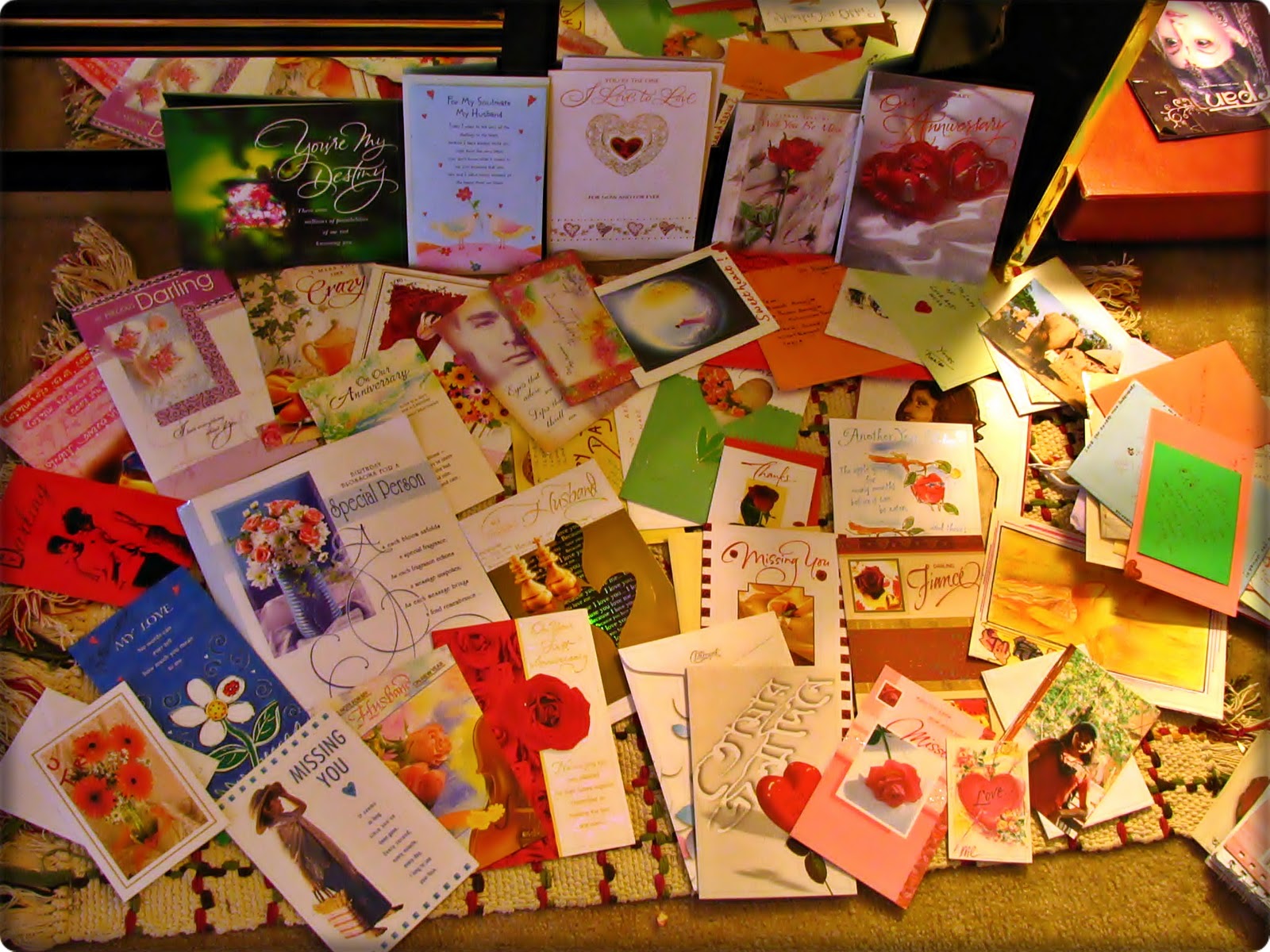
I would, however, end my blog post with an unromantic personal revelation. Last evening as I was cleaning up my apartment, I discovered the burlap full of love notes and cards that I had sent my husband via the Great Indian Post before we got married. The box had been marinating in our closet since a time out of mind. I had first discovered the box two days after I came to stay with him, and that was four years ago, that time I had tenderly gone through the mushy revelations and prided myself for composing such priceless tokens of love. The total weight of my love notes was an astounding ten pounds; and since the airline would not allow me an extra-suitcase for my love letters, I had to discard them before we pack our suitcases for our journey back to India. I felt sad for a while thinking that I was jettisoning romantic love for the purpose of practicality, but these days the world demands you be practical and mature. Moreover, back in the apartment, when I discovered my husband deliberating which restaurant to take me to this evening, I realized that in the confusion, I may have struck the right note somewhere, albeit without knowing. I bade my love cards a final adieu and proffered to enjoy Valentine's Day in a more practical way.

Friday, February 11, 2011

On Books


Modern technophiles have been predicting the doom of books as we know them: the death of folios and quartos, hardback and shinning paperbacks. They envisage that in a few decades books are going to be a thing of the past and e-readers like Kindle, etc., would become the primary source of bookish delight. The steady rise in the market of wireless reading devices are pointing to the fact that people of our century prefer to travel light; the weight of heavy tomes is too much to carry about, instead they prefer to have them all compiled in a sleek, shiny pamphlet like device which they could conveniently use. I agree that I am myself thinking of buying such a device, still I cannot get over the old bookish feeling; can a wireless device, I wonder, replace the tactile feeling of paper on hand, the smell of antiquity laden in pages stored for a long time in a shelf, the yellowish corners, the bold letters? Is the intense wish for convenience robbing us of all that we held true for centuries? Is the biblioclasm brought on by the tech-revolution, the sudden infernal cataclysm, finally killing the tradition of reading books the way they are naturally meant to be read. Are we, maddened by a sudden concentration of technological power, forgetting the great history that spreads behind us of inscription and what it had meant for us? 

William Caxton in 1476 printed the first book, and since then the lamp of literacy began to spread its light throughout. Before the advent of the printing press manuscripts were written by hand and preserving books had been a laborious task. But as soon as people learned the art of printing, they took advantage of technology to preserve wisdom. Judging from this angle, the rise of wireless devices sound sane, even justified; it becomes a case of passing the baton. Technology today, however, is highly vacillating, a new gadget becomes defunct in only a few months, in such a circumstance can we trust the irresolute hands of technology to guard the nobility of the thing that mattered to us most -- our books. What will happen in a few years, I ask. Possibly newer technology will arise. We will discover new ways to read, new gadgets will overtake old devices, and the weight of manuscripts will be reduced to a zero. If such a thing happens we shall have to accept the shift with open arms, nevertheless, we will regret the absence of certain things that reading in the traditional sense entailed.

Books mold us. They create our character and externalize our brains. Take a look at the books you have acquired over the years; don’t you think that those tomes have a story to tell? The shift from fairy tales to comics, from science fiction to Shakespeare, from love lyrics to essays; in other words from childhood preferences to titles chosen in maturity testify to a growing mind. The presence of old books is reassuring; their smell almost motherly. Without your direct acknowledgement, your old books have become one with you, and they have stayed with you through thick and thin guarding you with the warmth of the knowledge they have poured on you.  In a room surrounded by books -- torn, smelly, and old -- you tend to feel more at home than in an empty house with only a shelf displaying a wireless device. The pride in flaunting the collection you have laboriously gathered over the years is nothing short of sensational. I wonder how modern gadgetry can replace this satisfaction.

Physical presence of books in our lives goes deeper than we think. When I first came to USA from India several years ago, I felt lonely and friendless; and in my lonesome read a book called Namesake written by Jhumpa Lahiri. It is a novel about an immigrant Bengali woman and how she coped with the transition from a traditional family life in India to a nuclear existence in USA. Her story read like my story; I felt that the author has emphatically written my history and my future. And I remember holding the book close to my heart drawing strength from it to survive in an alien landscape. I still have the book, and the even though I haven’t studied it in a while, I feel a strange, almost familial attachment to it. How an electronic book can replace this feeling, I wonder.

As I was browsing through my collection of books yesterday, sorting them, choosing the ones to keep and discarding the titles I thought I wouldn’t need anymore, I couldn’t help but feel a little perturbed. The logical part of me dictated that I must discard certain titles since I couldn’t carry it all back to India, assuring me that these days bookeries in India carry all kinds of books; still I felt sad thinking what hands would sift through the pages of my discarded books, what hands would imprint their marks on them. I hoped they went to worthy hands that would love and treasure them. Still all is a surmise now. Shakespeare was true when he said in sonnet 73 the following:
 This thou perceivs’t, which makes thy love more strong,

To love that well, which thou must leave ‘ere long
.

To me the thought of leaving behind the books that have comforted me in lonely hours, matured me when I ran to them frustrated by the unceasing hum of the laptop, embraced me and taught me, is similar to leaving behind a part of me.  Still it is satisfying in a way to think that the fragments of the moments of triumphant absorbing of written wisdom will remain with me, half forgotten, half remembered, forever.

The wireless devices available in the market may include the substance of the books, but the emotional weight of my once owned library, their physical evidence would nowhere be found. The fickle newbie technology will yield brilliant magic tricks, one outwitting the other, and, in the middle of it all,  will try to try to eat away our love for books, but without books we are a set of wayward travelers with nothing to glue us to our foundation; without books  we "might melt into the airwaves, and be just another set of blips."


  Reference: Due Considerations by John Updike

Wednesday, February 9, 2011

Deal or no Deal -- An account of my Craigslist transactions


What a piece of work is man! how noble in reason! how infinite in faculty! in form and moving how express and admirable! in action how like an angel! in apprehension how like a god! the beauty of the world, the paragon of animals! -- Hamlet quote (Act II, Sc. II).

Human beings are such fascinating beings, and the more you know them the more you realize they are perhaps the most intriguing creature in the universe, apart from invisible aliens, of course. My recent knowledge about humanity is totally based on earthy experience though and has nothing to do with aliens, spaceships, or robotic creatures. Recently, I have had the fortunate chance to meet a sea of myriad humanity--some strange, some nupson like, some smart, some more balatronic than can be described, and a handful of standardized normal specimens. 

My fortunate encounters with this sea of eclectic Homo sapiens hitherto unknown to me were the result of the ads I posted on Craigslist. My husband and I are on the brink of a big move and needed to sell the furniture and other items of our household; hence we created an account and listed the items that were for sale. Think of a time before a big storm when nature usually sits breathless resting itself for the big strike. The initial moments after we posted the ads seemed similarly benign and calm to me. And then the storm came striking the shore first in the distance and then started spreading, its boom and uproar broke reboant on our lives. We received calls in great profusion; the phones never stopped ringing. I felt as if I was running a call center in India, a task, you are fain to think, coming naturally to Indians. Unfortunately, I don’t belong to the revered clan, and after a brief period of forced enjoyment, began hating the task only to forcibly starting to like it when the thought of Jacksons and Lincolns crossed my mind. To cut the long story short and head to the crux, much to my dismay, I attended the calls. Some of our stuff sold pretty easily and we thought that the rest would go effortlessly as well. Only it didn’t.

After the first week of grand success, I began to think of myself as a Craigslist diva with tips and tricks under her belt ready to unleash at a moments notice. I assured my husband who had started to think of Goodwill and Salvation Army already, to cool down and let the cash flow. Tell me- after turning off the hypocritical signal, of course-- is there a better charity than self-charity? Besides most of my household stuff cost a good deal of money, and I didn’t want to let them go without some compensation. Call me human or sub-human; I am practical when practicality calls. So, there I was ready to pocket a truckload of cash, but my (ig) noble intention took a ghastly turn in a few days.  My cecity to the inefficiencies and fallacies of humanity, that hadn’t bothered me much before now, took an illuminated turn. I saw the light, if you know what I mean. In case you don’t, take a look at the two priceless responses to my postings that I received in my inbox: the first is a reply to our posting of a chest of drawers, and the second a response to our posting of our dining table that included an area rug for free. Here, I must tell you, that the first one was harder to digest than its successorJ. And these two were just prologues, previews, if you will, the real show was yet to come.


When I look back at my Craigslist encounters with the express intention of creating a list of characters that deserve some kind of award or special recognition for the marvelous character traits they effortlessly displayed, I find myself grappling in a sea of candies unable to decide which one to eat and which one to not. But in a story there can be no more than one protagonist, one antagonist and a couple of very important characters. Hence I have condensed my list and have drawn out the finest few who deserve due mention in my humble blog post for their extraordinary character and nature. I wish I had peacocks and monkeys, or at least Dundies to present these glorious few with because, to me, they are the epitome of small town virtues, the real mirror, and the microcosm of the world they came from; and they are chosen here based on the degree of weirdness they displayed.

The first position has to go to a woman who came to visit our abode to check out the stuff we had for sale. But she put a lid on the proceedings as soon as she had walked into our apartment. She was a middle aged white lady with distinctly southern looks, disheveled straw colored hair, and wore a pair of baggy trousers and a plaid shirt. She came with a child, a thin, pale looking individual that had an undeniably hungry look in its eyes. The lady appraised my husband and me for a second or two, judging us from head to toe like a medical practitioner would inspect an immigrant that had disembarked at Ellis Island than anything human. With every passing second she grew paler, until a time when she looked positively vampiric; doubtless convinced that I was a wicked witch of some kind, she held the child tightly by its hand. She fumbled, and in a word of two said that she would talk to her "sister" who wanted to buy the "things" from us, and would come back later. The poor lady had forgotten, probably under the grip of fear, to even see what we had for sale; but we thought it would be better to let her go. Her sister never called and neither did she.

The second position goes to another lady who called us one Sunday forenoon and inquired about the couch we had for sale. That morning I had shoved the telephonic duty to my husband and waited to judge his professional skill at dealing with weirdoes, or should I say, masterpieces of humanity. He started off naively, innocent as he was -- an academic in every sense of the word, he is an angel in human form-- but even angels have breaking points; innocence is short lived. The lady that called us asked my husband a series of questions about the couch to which he replied correctly; to my amazement, he gave her a long of positive points about the couch, which I believed he was too inattentive to notice. But while I was correcting my viewpoint, the woman on the other side continued her conversation with my spouse. I heard him tell her that the couch was in perfect condition and that we still use it. To this the woman gave a sharp yowl, which despite being only faintly audible, struck us like a steam hammer. "What do you mean you use it? How do you use it?" she questioned with marked displeasure. Both my husband and I were at the time under the impression that a couch is a necessity, not an accessory in a home. My husband told her in a few words about our daily couch using technique on which she brooded for a trice. Conversation continued with more questions thrown at us regarding the material of the couch, its warranty, the years it had spent in our home, etc. Finally, the tête-à-tête ended with her telling us that she was looking for something different and my husband apprising her the sacred words that you get what you pay for.

Ultimate consternation, however, came in the form of an Indian lady, a fine female who snatched the third position in this list from other worthy contenders.  She called me no less than six times about my fancy professional series microwave oven, and every time she wanted me to lower the price. I illuminated her with the fact that the ad contained the words "price non negotiable"--which, I thought, she had inadvertently missed-- but she wouldn’t have it. I guess she felt that being an Indian undoubtedly qualified her to a deserving special discount; she went on with her appeal. Somehow overcoming the strong desire of shouting at her, I calmly informed her that I had no intention of giving her any special discount on the already heavily discounted price. Later that week, she called again having seen the ad reposted on Craigslist, and this time my husband picked up her call. She asked for the same discount to which my husband, despite my vehement disapproval, agreed, and gave her our address and arranged a time she would come to pick the item up. Only that she never came. When the appointed time had passed we took it for granted that her watch followed the Indian Standard Time and decided to wait. After an hour of two if breathless suspense, my husband called her and she said that she had found another "good" microwave oven and wouldn’t come. That evening, after a trying few weeks, I realized that enough was enough, and ended up giving away our stuff to a friend. All that remains are going to Goodwill and Salvation Army in a few days.

P.S. My sincerest apologies go to the following gracious and worthy contenders who didn't make it to the weird list: the African American family that came to buy my bamboo rug and ended up mentioning that the bamboo "thing" wasn’t a rug at all, and wished I had been more specific in my ad (which said "Bamboo Area Rug for Sale" and included the quality of the material in the specification list too) about the material; to the Chinese gentleman who wanted to buy "everything" I had provided I gave him all for the grand price of fifty dollars; to the young lady that emailed me about my area rug to whom the sentence "all items must be picked up" made no sense, and who wanted to give me ten dollars less than the price asked for provided I meet her at a designated place with the item.