

Wednesday, January 30, 2013
Peace, at last
Not having wielded the pen for days at length, I
felt intimidated about the right hand’s capability to beget any words on paper.
This intimidation led to uncertainty and a lack of confidence in self’s capacity
to craft a sentence. And then when against my wishes I sat at my desk and
forced myself to grab the fountain pen and write whatever comes to my mind, the
words started flowing. Although there was a slight hesitation in the beginning,
but then everything seemed all right; I wrote for one hour and when I put my
pen down I realized that my cold sudoriferous hand has written twelve pages of my life story
with the following word of advice directed to the self in unequivocal terms:
write every day if you wish to call yourself a writer in future years! Unlike
most self-directed advice issued by the mind, I intend to strictly follow this
one. If you are a writer then, mon amie, never let a hiatus transpire your
writing life if you don’t want nightmares of an exhausted writing life haunting
you at night.

Wednesday, October 17, 2012
Mean, Mean Chowmein

Mean, Mean Chowmein
Remember the Wodehouse classic Jeeves and the Old School
Chum, wherein the writer pens down the distressing events that unleashed in the
home of Bertie Wooster’s pal Bingo Little because of the advent of a certain
food-critic Laura Pike? The said Pike disgorged such horrific (mis) statements
about Bingo’s eating habits and the food he consumed that the peace of the
Little nest was completely shattered. Thanks to the cream of Jeeves’ cranium,
after a troubling time at home, the Pike was extricated from the Little
set-up and sanity restored to its
throne.
In the early afternoon of stark reality, I am quoting the
truisms of Wodeshouse fiction because the statements issued for the benefit of
the multitude (The Mango People: read Robert Vadra :-)) by the Khap compels me to consider the idea that we too
like Bingo Little need a Jeeves to mundify our social system. With the Khap
operating on the premises and issuing such noble avowals as Chowmein—yes that
humble delicacy we all enjoy— being culpable for sexual assaults on women, I
cannot but raise my hands and invoke the holy spirit of the butler to save us
from heading to the Purgatory!
As I lay praying, I hear the voice of conscience inside me
telling me to stop and consider the logic behind the septuagenarian sentiment
of high-fat foods leading to rapes in the Indian society. For a while I search
and search but can locate nothing. May be I am hidebound in my inability to
establish even an iota of logic behind the statement that fat foods –chowmein,
burgers, pizzas, etc.— are responsible for sexual assaults on women. I find
myself asking how these foods corrode the human conscience and the moral lining
of the patriarchal intestines and ‘force’ naive males to commit rapes. How
indeed do these foods, chowmein most importantly, with their spicy, polluting
quotient erode the ethical setup of the male-brain? That the Khap could equate
rape with chowmein makes its members even greater verbarians than Alexander
Pope. Don’t you feel that abaxial though their argument may seem, the Khap
should be awarded for the novelty of it nonetheless? Only heightened
intellectual ability coupled with years of academic labor can lead to such
high-class wisdom that can put two asymmetrical social elements, one a pillar
of human sustenance, i.e., food (regardless of it being high or low in the fat
content) and another the basest of crimes performed in society, i.e., rape, on
the same level.
And yet, all the while as we discuss and split our remaining
hairs in our quest to decipher the invisible, esoteric equation behind the Khap
argument, we miss the most important point: we are all rapists. Don’t stare
goggle-eyed at me, and please don’t drop that drink on your snow-white table
cover. I know what you are thinking, but trust me I am not talking piffle. Let
me clarify my assertion, which is not my assertion at all, but the nugget of
truth, the quintessence of reality Khap put forward yesterday; I merely did the
math. The Khap said that chowmein leads
to rape, therefore every rapist eats chowmien; or in other words, everyone who
eats chowmein (and that includes children, women, female, male, cats, dogs,
rabbits, etc, and our brethren who sell the delicious rape-inducing delicacy as
well) are rapists or potential rapists. Beware of thyself, noble scholar, thou
art a rapist!
I see myself rushing to the mirror to inspect the grinning
face of an impending rapist; I don’t see anything that remotely suggests my
wish to pillage a youth of my community. Am I missing it, I wonder? Do take a
look at your reflection and let me know if you can see any rape-wrinkles, any
frown lines or acne spots which might be a precursor to your crime.
As I finish my blog post the epicurean soul suggests that I
need some comfort food to stiffen my sinews and summon up the blood. I can see
a plateful of slender serpentine threads dipped in soy sauce and stir-fried
with meat and veggies in a pool of oil. The delicacy redolent in her white dish
beckons me, and I cannot but surrender. Chowmein, thou “fruit of the Forbidden
Tree” your taste will bring rape and desolation into this world, and no great
man can restore us to our blissful seat! Alas, innocence is lost! With such
contingencies as the loss of Eden (not Eden Gardens) in my mind, I call up my
favorite Chinese take-out destination and place my order: One plate of mixed
Hakka noodles with a generous dash of the rape-spice :-)
Have a good one, dear friends!
Notes: "Khap
panchayat is the union of a few villages, mainly in north India though it
exists in similar forms in the rest of the country. Lately they have emerged as
quasi-judicial bodies that pronounce harsh punishments based on age-old customs
and traditions, often bordering on regressive measures to modern problems."
Don't eat chowmein, it leads to rape, says Haryana khap leader: :http://indiatoday.intoday.in/story/khap-rape-chowmein/1/225031.html
Chowmein: http://en.wikipedia.org/wiki/Chow_mein
Image Courtesy: http://ayeshahaq.wordpress.com/2009/05/06/chicken-chow-mein/
Sunday, April 22, 2012
The Train
The train lurch its way to a known destination
Outside islands-neighborhoods appear and disappear
The train stops at one station
And then at another
As if to judge the aspect of the defeated contenders--the island-neighborhoods
Inside the train a sea of
gadget holding women tapping their
toes to inaudible music.
And in their middle there I sit
Just another face
thinking of the train and myself
on my way back home.
Tuesday, January 10, 2012
The voice of Charles Dickens
On the subject of Charles Dickens, I can unequivocally state that we, meaning the general reading public, seldom devote our leisure in making a study of his work. We have writers more jaunty than Dickens, pastimes that glitter with dashing prosperity and make the writer look old and emaciated in comparison. Yet, on such celebratory eves as the Christmas or when encountering travails in the face of our great expectations, we recall his baritone, a voice that booms with surprising warmth from the crevasses of his yellowing masterpieces.
Recently, I have taken it upon myself to compose an article of Charles Dickens for a journal celebrating the bicentenary of his birth. This activity requiring a thorough study of Dickensian texts enabled me to walk back into the jorum of the past when the novel in the hands on such masters like Dickens, Trollope was growing up. I re-read the Great Expectations, Oliver Twist and A Christmas Carol in that order and appreciated them now more than ever. The voice of the author was what struck me more than his stories; the warm tone that modifies itself to suit the perspective of the speaker, to suit the movement of the text and the narrated incidents is as natural as it comes.
While reading Kingsley Amis my appreciation of Lucky Jim was somewhat detracted by Amis’s circumlocutory descriptions, over-vivid, over-English; in Dickens, however, we see a transmogrification of such genteel Englishness; here we have the boisterous, garrulous friend of a writer who puts his warm hand on your shoulder and makes you see the England he himself saw and through it the world at large. And you can never miss the vision, which at the end of the story is sure to give you some new perspective on life, an end which all books hope to achieve and few do. And I am glad that in an age of stark reality when the society was undergoing a shift from the idyllic to the modern Industrial era once and for all, the irrealist Dickens painted life in such a way that despite the bleakness of society wherein they had been begotten, their outlook is surprisingly refreshing and creative.
Despite the structural incoherence, directional fallacies and miscellany of characters, it is Dickens’ voice, unique, immanent that comes out disconcertingly amplified and acts as a appeasement for all the drawbacks one must encounter in quintessential Dickensian creations. Vladimir Nobakov, to whom Dickens meant a study of his voice and its inflections, suggested: ‘We just surrender ourselves to Dickens’s voice—that is all [. . .] the enchanter interests me more than the yarn spinner or the teacher [. . .] this attitude seems to me to be the only way of keeping Dickens alive, above the reformer, above the penny novelette, above the sentimental trash, above the theatrical nonsense.’
It could be the serialization of the novels that led to this reality-imagination-correlation that is evident in almost all of Dickens’ novels. The serialization allowed readers to enjoy a stave or two of his stories and then return to their normal livelihood and then comeback in a week or two to the next imaginary installment. The feeling that the writer was a friend who came on a visit once in a fortnight or so to update them on the goings-on in the lives of some protagonist and his friends and foes gripped the public. And even now as you read Dickens you cannot escape the writer’s presence “at your elbow” directing and guiding the proceedings.
We may remember that most of Dickens’ novels are oriented in such a fashion that their succulence can be best tasted when heard rather than read. The audible capacity of Dickens’ work is, at least to me, best pronounced in A Christmas Carol wherein every episode be it the visits of the ghosts or the end when a modified Scrooge opens the window on Christmas Day with a heart brimming with celebratory excitement. Such moving scenes vibrant as if painted by hand are best appreciated when some voice adding its emotional inflections utters them to a group. Dickens himself well appreciated this audial quality of his works and may have intentionally oriented them in this special way. Dickens’s readers were, from the start, his ‘auditors’, who virtually heard the stories as reiterated to them by the author who later took it upon himself to make his real presence fundamental in the lives of his readers by embarking on his professional Reading tours in 1858. His devotion to his readers found reciprocation such that in all provincial cities and towns wherever his Readings were held people came in millions to catch a glimpse of the supreme actor who devoted his life like a suited thespian to the entertainment of the masses. The fact that all tickets were sold for the first New York Reading, amassing over $16,000 in receipts substantiates his popularity even in the USA.
Like Shakespeare Dickens’ appeal encompassing the learned few reached the masses, who embraced him not as a guest in their house but as their inmate. The view is supported by Charles Eliot Norton, the Harvard Professor of Fine Arts, who wrote in 1868: ‘No one thinks first of Mr. Dickens as a writer. He is at once, through his books, a friend. He belongs among the inmates of every pleasant-tempered and large-hearted person. He is not so much the guest as the inmate of our homes.’
Finally, we can conclude our discussion on the myriad minded Charles Dickens with the observation that even though the author-reader relation has overtime become abstract and formal such that many of us regard our readers as either an hostile, unappreciative group or people who are totally unreachable because of virtual noise and several other factors that render reader-writer communication implausible if not impossible. We do, however, have the option of walking back into the jorum of the past and let ourselves by inspired by the voice of Dickens who regarded any labor of communication with his readers as a labor of love and spared no efforts, however daunting they may be, to woo and win his public. May be the fullest and complete communication between an interlocutor (writer) and a receiver (reader) can only be possible when both parties work together towards that goal. In Dickens’ case both parties did work and that nexus lead to the creation of prose pieces that still shine with exquisite glitter among literary tchotchkes and masterpieces in the bijou shoebox of English literature.
Tuesday, December 27, 2011
Romancing with History: Part1--Visit to the Red Fort
 |
North-India is in winter a beauty to behold, we have mornings thickly laden with nebulous layers of fog and mid-afternoons and afternoons when the fulgent sun targets its mollified rays at the heart of the city thus radiating warmth and wintry torpor. It is also a time to travel. The citizens enjoy this period of appricity by discovering the great city and its environs.
 |
| A Foggy Morning |
This Christmas my husband and I had originally planned to celebrate the day by going to the St. James Church, one of the oldest churches in Delhi. However when we arrived at its premises, we found the church closed for the day and decided to visit the Red Fort, a monument I had long wanted to see.
 |
| Red Fort |
Built in the jorum of the Mughal Empire by the emperor Shah Jahan, this seventeenth century fort stands majestically is the pedestrian neighborhood of Chandni Chowk in Old Delhi. Against the backdrop of the watchet sky this Brobdinagian monument stands stolidly as a witness of the changing currents of time. It was from this virtuous place that the first Prime Minister of India, Pandit Jawharlal Nehru, delivered the famous speech "Tryst with destiny" at the stroke of midnight hour when India achieved its freedom on 15 Aug 1947. Every year on the day of independence the National Flag of India is hoisted at the Red Fort by the Prime Minister. As you reach the premises you would observe the red façade of the building with the tri-colored banner waving atop.

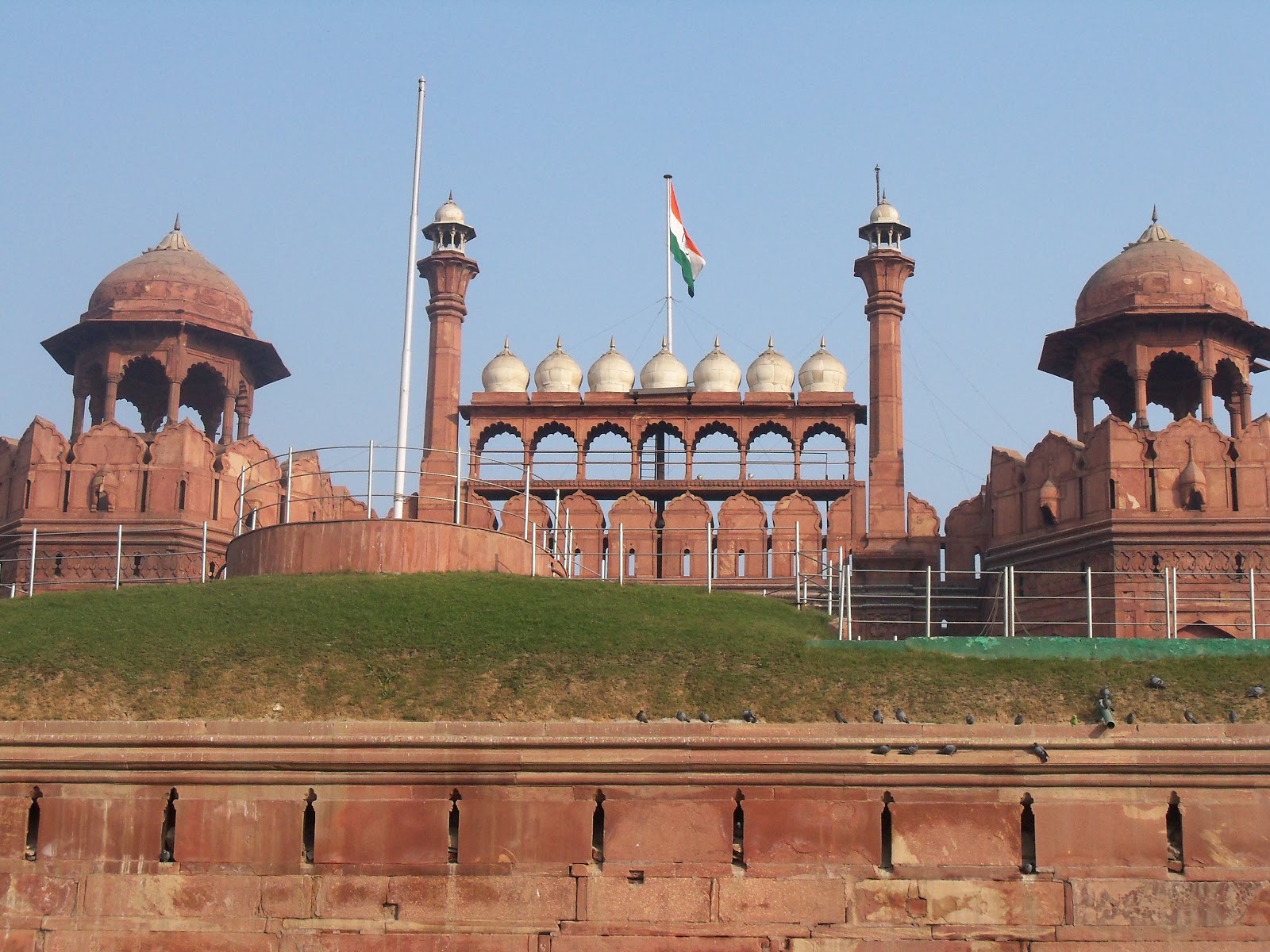
Made out or red sandstone this fortress is known for its grand architecture. The main entrance opens on to the Chatta Chowk, a covered street flanked with arched cells that used to house Delhi's most talented jewelers, carpet makers, weavers and goldsmiths. It now houses shops where you can find assorted collections of Indian handicrafts made of wood and brass and other materials(I go myself a couple of Rajasthani puppet dolls from here). As you walk down this dark, strepitous alley you will feel transported to another era, a bygone era whose relics lie before you. The curious eyes of travelers hovering over the two tiers (the second floor is officially closed) of this market suggest awe and inquisitiveness as to what lies beyond this narrow settlement.
 |
| The bazaar |
The Chhattar bazaar leads to a large open space where it crosses the large north-south street that was originally the division between the fort's military functions, to its west, and the palaces, to its east. Representatives of the Indian army stand guard at various points at this juncture. My grandfather who was a colonel in the Indian army narrated stories of the Red Fort and as I saw the tenement I recalled some of them.Beyond the Chatta Chowk is the heart of the fort called Naubat Khana or the Drum House. The musicians used to play for the emperor from the Naubat Khana and the arrival of princes and royalty was heralded from here.
 |
The Diwan-i-Aam |

The Diwan-i-Aam
The Diwan-i-Aam, which is the large pavilion for public imperial audiences, has an ornate throne-balcony (jharokha) for the emperor. The columns were painted in gold and there was a gold and silver railing separating the throne from the public. The cool white marble get-up that now stand frozen in time exude rich regal airs. A net is now drawn across the marble balcony separating the curious onlookers from the royal seat. Old glyptic ceilings hang surreptitiously from above; their intricate designs once studded with precious stones now lay bare like toothless old men showing their gums. The once stelliferous halls are now illuminated by humble halogens and natural light.
 |
The Diwan-i-Khas |
 |
The Diwan-i-Khas |
After you cross the hall of public audience you take a ramp down to an open courtyard richly platted with trees and other important buildings. The Diwan-i-Khas or “hall of private audience” is the first important building you will observe. In Urdu “khas” means special, and this hall was a special chamber used by the king when talking to his special guests. The room with openings of engrailed arches on its sides consists of a rectangular central chamber surrounded by aisles of arches rising from piers. The lower parts of the piers are inlaid with floral designs, while the upper portions are gilded and painted. Over the marble pedestal in its center stood the famous almost-mythical Peacock Throne which was removed in 1739 by Nadir Shah of Persia. It is said that the pavonine throne was an exquisite piece of Persian artifact curved in gold and studded with priceless gems and stones.

As you walk around the Diwan-i-Khas you can let your imagination conjure up from the tessellating pieces of history the golden Peacock Throne housed in the middle of the Diwan-i-Khas. The pillars impleached with majestic Mughal designs done in perfect symmetry will surely add their wonder touches to your imagination. One motif that particularly caught my attention was that of the scales of justice done in marble suspended over a crescent amidst stars and clouds in the northern screen of the Tasbih-Khana ('chamber for counting beads for private prayers').
 |
| Scales of Justice |

Through the center of the Diwan-i-Khas flowed the Nahr-i-Bihisht or the stream of ‘pairidaeza’. The whole get up is paradisal indeed and my view was reiterated by Amir Khusrow the famous 13th century Sufi poet whose verse “if there be a paradise on the earth, it is this, it is this, it is this” is inscribed in one of the walls of the tenement
.

The two southernmost pavilions of the fortress are zenanas, or women's quarters: the Mumtaz Mahal, and the larger, lavish Rang Mahal, which has been famous for its gilded, decorated ceiling and marble pool, fed by the “stream of paradise.” Of the two the Mumtaz Mahal has indeed experienced a transmogrification. Once a seraglio it acted as a prison in 1857 and now it is a museum housing treasures from the Mughal era: daggers and swords and armors, paintings and priceless texts handwritten in exquisite calligraphy, dresses (which will make you smile upon judging the average size of a Mughal emperor), potteries, carpets, traditional rugs and many more. My favorite among the displayed was an embroidered palanquin cover, now almost frayed and dirty yet still retaining some of the old design that some unknown hand or hands stitched on its surface.
 |
| Mumtaz Mahal Museum (this picture is from the web) |
As you walk around the open courtyard imbibing the priceless regal beauties stationed at arms-length you might, if you were a person with a strong linking for the artistic, take issues with the British administrative buildings built behind the garden which are now used by the military. These box-like buildings with their European modernistic façade seem anachronistic in the setting. Perhaps the builders were daunted by the finery of the Mughal art that they build themselves box-palaces just beyond its premises or they were so fond of the royal surroundings that they built their own tenements close to the artistic hearth so as to enjoy the beauty of the Royal fort all day long. Whatever the reason, the sanitarium like buildings will make you twitch your nose.
 |
| British Administrative Building |
Our tour around this ancient monument was over by 5:30 pm. Upon its completion we took a rickshaw (the hand-pulled ones are a relic :-)) and headed to the Chandni Chowk metro station, which is only a few kilometers from the Red Fort. The ride down the Chandni Chowk market bustling with activity, the smell of street foods, and the sight of sweets dipped in sugary syrup condensed the touristy feeling I had been experiencing throughout the day.
At home that night I cooked my Christmas meal: Roasted chicken with vegetables, mashed potatoes and gravy, homemade bread and fruitcake. As I did the dishes I couldn’t help but smile at the wonderful medley of experiences— Christmas meal, Mughal architecture, smell of Indian street food and Metrorail ride—which lay imbricated in my system. A Christmas well spent, is how I concluded my observations for the nox.

Subscribe to:
Posts (Atom)